Hedge, Wall or Fence? Reading a Field Boundary
Read a field boundary by its material, height, gaps, and position to understand how a hedge, wall, or fence shapes a walk through the British countryside.
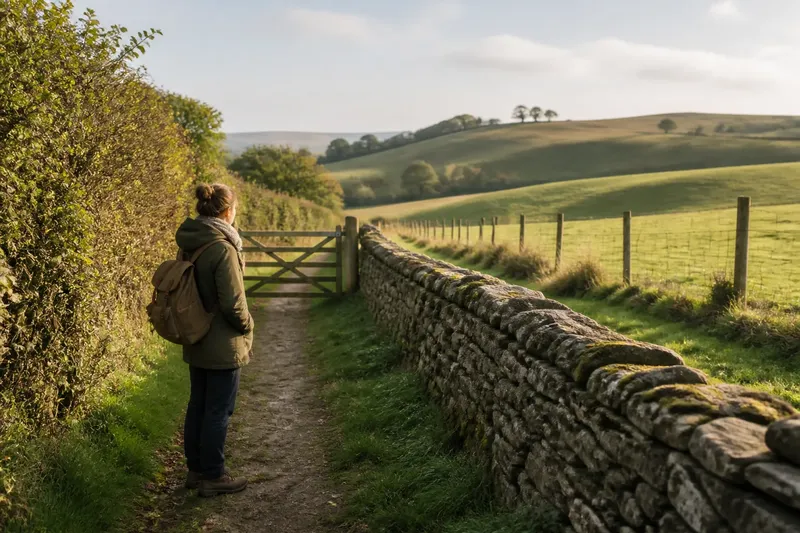
A field boundary changes the view before it changes the route. On a British country lane, a clipped hedge can hide a pasture, a dry-stone wall can reveal the slope beneath it, and a wire fence can make an open field feel close at hand but firmly out of reach. To read a field boundary, look at its material, shape, gaps, and position together rather than treating it as decoration.
Start with what the boundary is made of
A hedge is a living edge: shrubs and small trees woven, layered, or clipped into a line. Its surface is rarely uniform. Look for old stems within fresh growth, a mix of leaf shapes, and small breaks where the hedge thins. These details can make a hedge feel less like a screen and more like a narrow strip of habitat threaded through farmland.
A stone wall is built from pieces that remain visible. In dry-stone construction, stones are fitted without mortar, and the wall’s face often shows how local rock has been split or gathered. A mortared wall has a more continuous surface, though its stone, cap, and wear still give it a distinct character. From a footpath, notice whether the top stays level or follows the ground in short rises and dips.
A fence is easiest to recognize by its repeated parts: posts, rails, wire, or mesh. Timber rails may make a boundary visually open; wire can nearly disappear until it catches the light. A fence’s regular spacing often gives a field edge a measured, practical appearance, but that does not tell you who installed it or when.
Pause at a safe place beside the public path and identify the material before guessing its purpose. The first reading is usually the most reliable.
Read height, thickness, and the ground beneath
Height controls what a boundary lets you see. A low wall may frame a sheep pasture while leaving the far hills visible. A tall hedge can close a lane into a green corridor, then suddenly open the view at a gateway or bend. A fence may preserve a broad outlook while marking a clear limit.
Thickness matters as much as height. A broad hedge can have depth, with branches leaning into the field and a bank or ditch at its base. A narrow line of posts leaves the ground visually exposed. A wall may sit on a raised stone base or meet a sunken lane; either position changes how the boundary feels from walking level.
Check how the line meets the land. Does it climb directly over a ridge, bend around a wet hollow, or run beside a stream? A boundary that follows a contour can make the field appear settled into the slope. One that cuts across it may divide the view into sharply different planes.
Look at the ground without stepping off the path. A bank, ditch, or strip of rough vegetation can be part of the boundary’s form, not an accidental gap around it.
Notice what the edge reveals and conceals
Boundaries shape a walk through the countryside by controlling sightlines. A high hedge can keep a field out of view for a long stretch, while a gateway offers a brief look at livestock, a barn, or a distant ridge. A wall gives more glimpses between stones and over its top. Mesh can preserve the scene while making the separation unmistakable.
Sound also travels differently along an edge. Leaves can soften the impression of a road or rustle in a breeze; a hard wall can reflect a footstep or make a narrow lane feel more enclosed. A wire fence may be almost silent, leaving birdsong or wind across the pasture more prominent. Treat these as impressions of the place, not a code for what the boundary means.
Notice where your attention goes as you walk beside one. A hedge invites the eye to follow its uneven outline; a wall can draw attention to its stone pattern and changing height; a fence may lead the gaze through the field rather than hold it at the edge. The boundary is part of the landscape’s composition, even when it seems plain.
At a permitted viewpoint, compare the view from each side of a junction or gate without crossing into private land. A small change in position can show how much the edge is doing to frame the scene.
Compare boundary types without treating them as a code
It is tempting to assign a firm story to every material: old hedges for ancient divisions, walls for upland grazing, fences for modern farming. Such shortcuts can mislead. Boundaries are repaired, replaced, extended, and adapted; a material alone cannot establish a field’s age, ownership, or use.
Instead, make a modest observation and keep its limits clear. A thick hedge with mature trunks may have been managed over time, but its present appearance does not tell you when it began. A wall built from local stone belongs visually to its setting, yet it may have been repaired with newer material. A fence may be recent or longstanding; its posts and condition are clues to inspect, not proof.
Imagine you are walking a public footpath beside a pasture where a hedge ends at a stone wall. The hedge is dense near the lane, while the wall follows an exposed rise. You can reasonably note that one edge closes the view and the other marks the skyline; you cannot infer from that contrast alone why the division was made.
Use careful language in your own notes: “the wall follows the ridge” is observable; “the wall was built to stop animals crossing here” is a guess unless you have evidence. That distinction makes landscape reading more useful, not less interesting.
What can a field boundary tell you?
Does a hedge mean the field is older?
Not by itself. A hedge may be mature, recently laid, or replanted, and its appearance cannot date the field reliably. Record visible features such as thickness, species variety, and nearby banks without turning them into a historical claim.
Why do walls follow a ridge or slope?
A wall that tracks a contour may simply reflect how the boundary meets the ground, but the line’s purpose cannot be read from its position alone. From the path, notice how its height changes and how the view differs on either side.
Can I tell what a fence is keeping in or out?
Sometimes animals or crops are visible nearby, but a fence’s intended use is not always obvious. Stay on the public route and avoid touching or testing it; note its visible form and the land it borders instead.
What should I do if a boundary blocks the path?
Follow the marked public route and use the designated stile or gate where provided. If the way appears obstructed or unclear, consult the local rights-of-way information or ask the relevant land manager rather than climbing a wall or crossing a fence.
Use small details to make a field note
A useful note can fit in a few lines. Include where you were, what the boundary was made of, how it met the ground, and what it did to the view. Add one sensory detail if it matters: leaves brushing the lane, light caught on wire, or the cool shade beside a wall.
- Material: hedge, stone, timber, wire, or a combination.
- Form: height, thickness, gaps, bends, and changes in level.
- Setting: ridge, stream, lane, pasture, or field corner.
- Effect: what the edge hides, frames, or lets through.
- Certainty: separate what you can see from what you are guessing.
Keep observations brief enough to make while standing clear of gates and other path users. If a boundary has distinctive plants or stonework, a sketch of its outline may help you remember more than a broad photograph.
On your next walk, choose one stretch of hedge, wall, or fence and follow its line with your eyes before moving on. Reading a field boundary this way turns an ordinary edge into a precise note about how the landscape opens, closes, and guides your attention.